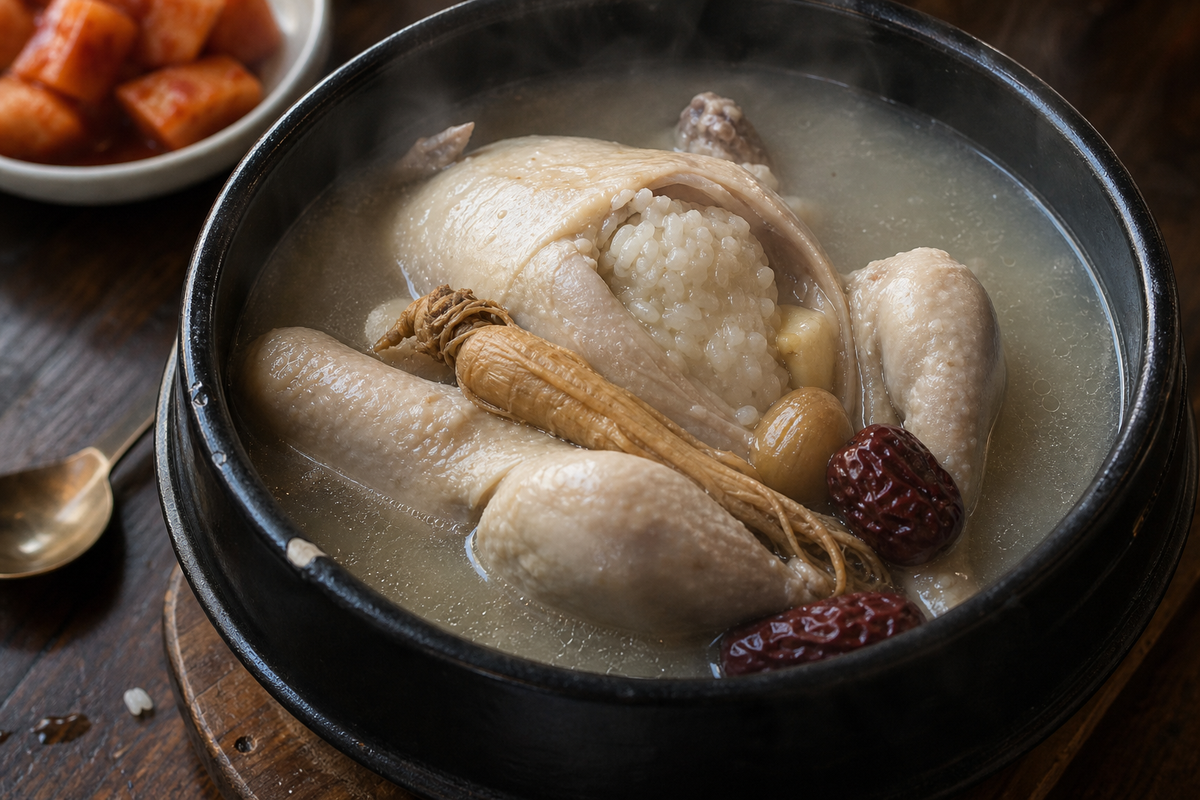
Samgyetang is a traditional Korean restorative soup made by stuffing a young whole chicken with glutinous rice, fresh ginseng, garlic, and jujube, then simmering it until the broth turns milky white. Honestly, the first time I tried this samgyetang recipe back in summer 2022, I ended up with watery rice porridge and a sad-looking bird floating in pale water. Four years later, I make it almost weekly in boknal season — and my Korean mother-in-law in Jongno finally stopped correcting me.
So here's the real deal. This is the version she walked me through, step by step, in her tiny tiled kitchen near Tapgol Park. No restaurant shortcuts. A whole young chicken (called yeonggye, 영계), about 600g. Sticky rice soaked overnight. Fresh ginseng if you can get it, dried if you can't. Garlic. Jujube. Water. That's basically it. The pot does almost everything else.
Good news for cooks outside Korea: you don't need anything fancy. H-Mart, your local Asian grocery, even Amazon will cover 90% of the shopping list. Active hands-on time? About 25 minutes. Below I'll walk you through the exact Korean ginseng chicken soup ingredients, three working variations (classic stovetop, Instant Pot, ogyetang), and the small rookie mistakes that ruined my first three attempts.
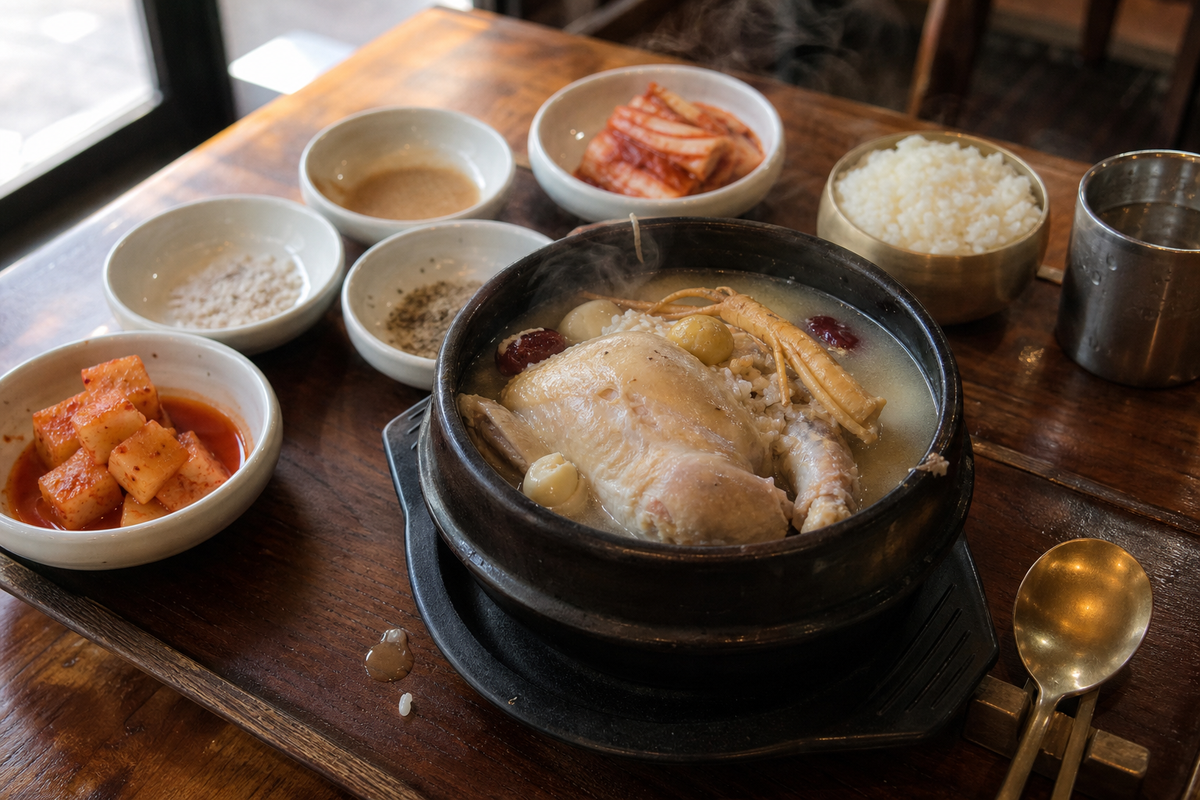
📊 Quick Comparison — Three Samgyetang Methods at a Glance
| Method | Cook Time | Calories (per bowl) | Best For |
|---|---|---|---|
| Classic Stovetop | 1 hr 30 min | ~620 kcal | Traditional milky broth, weekend cooking |
| Instant Pot / Pressure Cooker | 40 min | ~610 kcal | Weeknight dinner, deeper flavor in less time |
| Ogyetang (Black Chicken) | 2 hr | ~580 kcal | Boknal tradition, richer iron content |
🔍 What to Know Before You Start the Samgyetang Recipe
One rule. Repeat after me. Use a young whole chicken. Not a Costco roaster. Not a Whole Foods organic bird the size of a small turkey. In Korea this small bird is called yeonggye (영계), usually 500–700g — basically a Cornish hen. Why does it matter? A 1.5kg chicken physically won't fit a single-serving stone bowl, and by the time the meat finally tenderizes, your stuffed rice has turned into wallpaper paste. I learned that one the hard way.
The second non-negotiable: sweet rice, also called glutinous rice or chapssal (찹쌀). Regular short-grain Calrose? It works, sort of, but the texture is wrong. Soak the chapssal at least 2 hours. Overnight if you remember. Skip the soak and you'll bite into half-cooked rice while the chicken is already collapsing — ask me how I know.
Fresh ginseng (insam) is ideal. Dried ginseng (susam, 수삼) is the realistic option for most of us abroad. If you only have dried, just simmer the soup 10 minutes longer. The flavor catches up.
Foreigner shopping tip from someone who's been there: at H-Mart, look in the frozen aisle for a vacuum-sealed pouch labeled "Samgyetang Kit" or "삼계탕 재료" — usually $4–6. Inside you get dried jujube, ginseng slices, astragalus root (hwanggi, 황기), and sometimes a chestnut or two. Buying these separately costs almost double and the small bags expire before you finish them.
🍲 Classic Stovetop Samgyetang Recipe — The Original Way
Serves: 2 • Active time: 25 min • Total: 1 hr 30 min
Ingredients:
- 2 young whole chickens (500–600g each), cleaned
- ½ cup glutinous rice (chapssal), soaked at least 2 hours
- 2 fresh ginseng roots (or 4 dried slices)
- 6 garlic cloves, peeled and whole
- 4 dried jujubes (Korean red dates)
- 2 peeled chestnuts (optional, but nice)
- 1 piece astragalus root (hwanggi)
- 2 green onions, chopped — for serving
- Sea salt and ground black pepper, to taste at the table
- 8 cups cold water
Step-by-step:
1. Clean the bird. Rinse inside and out. Trim the excess fat near the cavity and around the tail — this fat is what turns the broth greasy if you leave it. Pat dry.
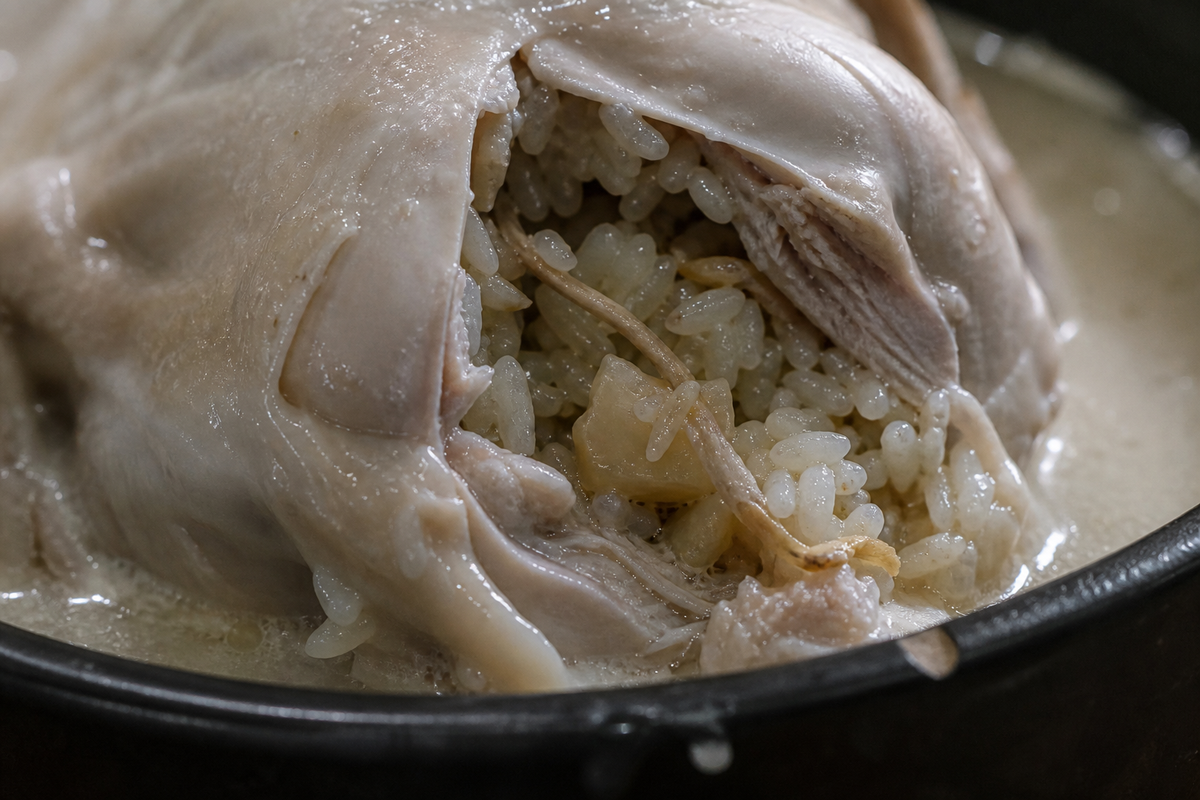
2. Stuff the cavity. Drain the soaked rice. Spoon about ¼ cup of rice into each chicken, then push in 3 garlic cloves, 1 ginseng root, and 1 jujube. Don't pack it tight. Rice expands. I've split a chicken open mid-simmer by over-stuffing — not pretty.
3. Seal the opening. Cross the legs and tie with kitchen twine. No twine? Stick a wooden toothpick through the skin flap. Either works.
4. Build the pot. Place chickens breast-up in a heavy Dutch oven. Pour cold water in until it covers them by 2cm. Drop in the remaining jujubes, the astragalus root, and the chestnuts.
5. Boil, then skim. Bring to a hard boil over high heat. As soon as gray foam appears, skim it off with a spoon. This step is the secret. Skip it and your broth stays muddy instead of going milky white.
6. Simmer slow. Reduce heat to medium-low. Cover partially. Cook 1 hour to 1 hr 15 min. Don't crank it. Boiling shreds the meat into stringy bits.
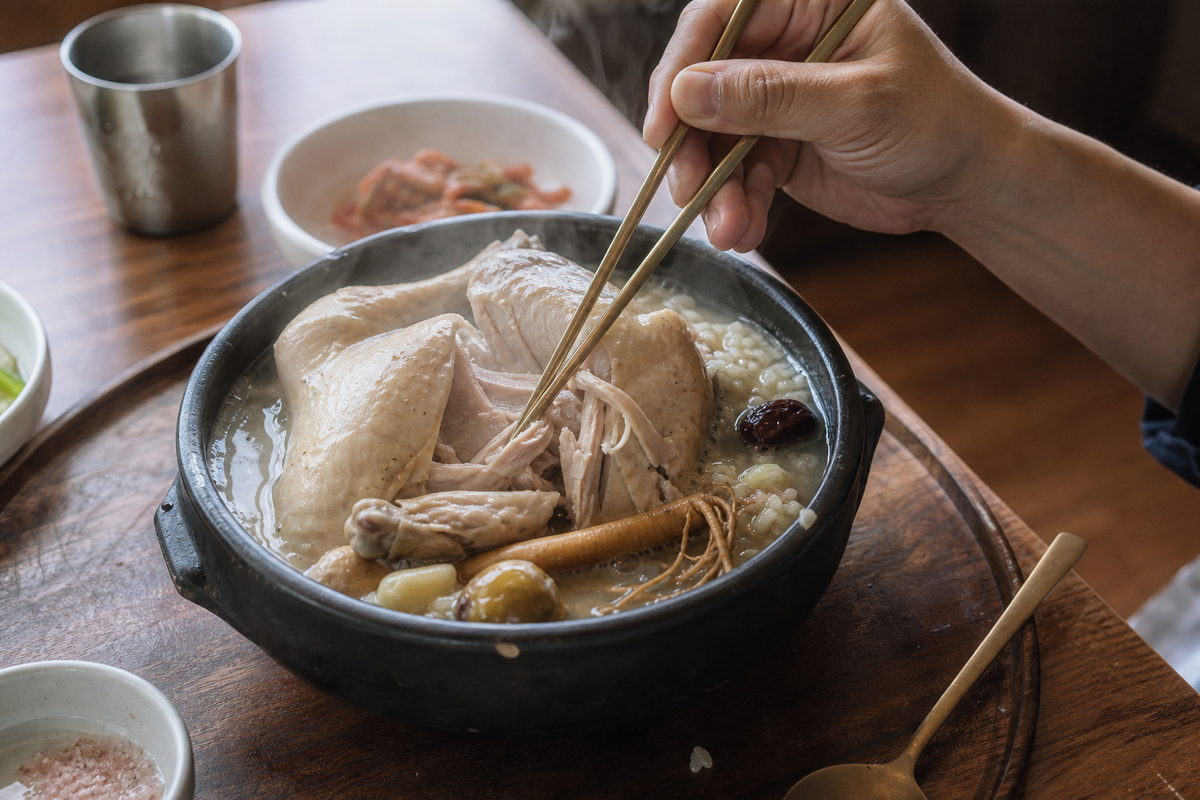
7. Check doneness. Push a chopstick through the thigh — it should slide through with zero resistance. The broth turns pale ivory, not clear. That's how you know.
8. Serve hot. Transfer to a stone bowl (ttukbaegi, 뚝배기) if you own one. The stone holds the heat so the soup keeps bubbling at the table. Sprinkle green onions on top. Salt and pepper go on a small side plate — you season each bite, not the whole pot. That's the Korean way.
⚡ Instant Pot Samgyetang Recipe — The Weeknight Hack
I'll be honest. This is the version I actually make 8 nights out of 10. The Instant Pot delivers the same fall-off-the-bone texture in less than half the time. Ingredients and stuffing? Identical to the stovetop method above.
Pressure cooker steps:
- Place stuffed chickens upright in the Instant Pot inner pot
- Add 6 cups of water (less than stovetop — pressure doesn't evaporate)
- Drop in jujubes, astragalus, and any remaining ginseng
- Seal the lid. Cook on Manual / High Pressure for 28 minutes
- Let it natural release for 10 minutes, then quick release the rest
- Open slowly. The steam smells incredible — garlic, ginseng, chicken, all at once
One warning. Seriously. Do not fill above the max line. The chicken renders fat, the rice expands, and if you're greedy you'll spend 20 minutes scrubbing the lid valve. I did this once. Never again.
🌿 Ogyetang — The Black Chicken Variation
Ogyetang (오계탕) swaps regular yeonggye for Korean black-bone chicken. The skin is darker, the bones literally black, and the broth comes out richer and almost gamey. Traditionally Koreans eat it on the three boknal days (mid-July to mid-August) because folk medicine says black chicken replenishes iron and stamina lost in summer heat. Whether that's true or not — it tastes incredible.
The recipe is the same as classic stovetop, with one change: simmer for 2 hours minimum. Black chicken meat is denser and tougher than yeonggye. Some Jeolla-province versions add a small piece of milk vetch root and a handful of dried lotus seeds. Expect to pay $12–18 per bird at H-Mart vs. $4–6 for regular yeonggye — but if you only make it once a summer for boknal, splurge.
💡 Which Samgyetang Version Should You Make Tonight?
First-timer, or guests showing up at 7? Classic stovetop. The visual of two whole chickens steaming in a deep pot is half the experience. Plus the technique forgives small mistakes.
It's Tuesday, you're tired, you want soup in 45 minutes? Instant Pot. From shopping bag to bowl in under an hour, no babysitting the burner.
July, peak boknal, or you're recovering from a cold? Ogyetang. The longer simmer pulls every bit of collagen and minerals out of the bones. Koreans treat this almost like medicine, not a meal.
Counting calories? All three sit in the 580–620 kcal range per bowl. To cut more, pull the skin off before serving — that saves roughly 120 kcal. Skip the chestnut and you save another 30. Don't skimp on the broth though. That's where the magic lives.
📅 Practical Tips — Shopping, Storage & Seasoning
Where to buy ingredients abroad: H-Mart, Hannam Chain, and 99 Ranch (in California) stock everything fresh. No Korean grocery within driving distance? Amazon and iHerb both ship dried jujube, glutinous rice, and ginseng slices to most countries. One thing — don't substitute Medjool dates for jujube. They're way too sweet and they'll throw the whole broth off.
Make ahead: Cooked samgyetang keeps 3 days in the fridge. Reheat gently — bring it to a bare simmer, not a hard boil, or the meat shreds. Freezing technically works but the rice goes mealy after thawing. I freeze the broth alone and add fresh stuffed chicken on cooking day.
What to serve alongside: Traditionally just three things. Aged kimchi, kkakdugi (cubed radish kimchi), and a small saucer of salt-and-pepper mix for dipping the chicken pieces. A shot of insam-ju (ginseng soju) is optional. Older Korean uncles will tell you it's mandatory.
❓ Samgyetang Recipe FAQ
Q1. How many calories are in a bowl of homemade Korean ginseng chicken soup?
A standard serving with a 600g young chicken, stuffed rice, and broth runs about 610–620 kcal. Remove the skin and it drops to roughly 490 kcal. The broth alone is around 90 kcal per cup — the same as a low-fat latte.
Q2. Can I make samgyetang without fresh ginseng root?
Yes. Without ginseng it technically becomes baeksuk (백숙), the same dish minus the ginseng note. To keep the ginseng flavor without buying fresh root, drop in 2 teaspoons of dried ginseng powder or 1 ginseng tea bag during the last 20 minutes of simmering. Works surprisingly well.
Q3. Why is my broth clear instead of milky white?
Two reasons. Either you didn't skim the foam in the first 10 minutes of boiling, or you added too much water. The milky color comes from rendered chicken collagen — keep water just 2cm above the bird and simmer (don't boil) the entire hour.
Q4. My pot is too small and the chicken won't fit. What now?
Good question — happens all the time. You have two options. Either split the chicken down the back (butterfly it) so it lays flatter, or use the Instant Pot which has a deeper, narrower shape. A 4-quart Dutch oven fits exactly two 500g birds; smaller pots usually fit only one.
Q5. Is samgyetang safe during pregnancy?
Most ingredients are safe, but Korean OB-GYNs generally recommend skipping fresh ginseng root during the first trimester. Make it as baeksuk instead, or use only jujube and garlic. Always check with your own doctor first.
And that's the full samgyetang recipe playbook I've refined across four summers of boknal dinners, two broken Instant Pot lids, and one very patient Korean mother-in-law. Start with the stovetop version once to feel the rhythm — the skimming, the slow simmer, the moment the broth turns ivory. After that, switch to the Instant Pot for weekdays. The smell of garlic, ginseng, and chicken filling the kitchen is honestly reason enough to keep this Korean ginseng chicken soup in your regular rotation, not just on the three hottest days of the year.
'레시피' 카테고리의 다른 글
| 미슐랭 선정 냉면 맛집 7곳 | 서울·부산 직접 먹어본 솔직 후기 + 지하철 (0) | 2026.05.23 |
|---|---|
| 【2026最新】コングクス レシピ完全版|ソウル在住7年が教える本格・時短・アレンジ3選 (1) | 2026.05.23 |
| 콩국수 만들기 황금비율 | 비린맛 없이 우유빛 콩물 8분 레시피 (0) | 2026.05.23 |
| 【2026最新】ミシュラン冷麺 ソウル&釜山 絶対行くべき名店7軒 完全ガイド (0) | 2026.05.23 |
| Best Naengmyeon Restaurants Seoul & Busan 2026 | Michelin Cold Noodle Guide (0) | 2026.05.23 |


