Inwolsa Temple Gangneung (인월사) is a rebuilt Korean Buddhist nuns' temple in Nangok-dong, Gangneung that won the 53rd World Architecture Award Grand Prize in March 2026 — three years after it burned to the ground in the 2023 wildfire. If you only have one cultural stop on your Gangneung trip this year, make it this one. I drove out from Seoul on a Friday morning in April and spent about three hours on site. Honestly, I came back the next sunrise too. That's how good it is.
Here's the thing. The building itself is the pilgrimage. Below is everything I actually wish I'd known before going — the free parking situation, the photo spot Korean visitors call "두 개의 달," how to chain WA Award temple Korea 2026 with Terarosa coffee and Chodang sundubu, and the one subway-less corner of Gangneung you'll be standing in.
📊 Gangneung Buddhist temple rebuilt — Visit at a Glance
| Item | Detail | Foreigner Tip |
|---|---|---|
| Address | Nangok-dong (난곡동), Gangneung — 2.4 km west of Gyeongpo Lake | No subway. Taxi or rental car only. |
| From Gangneung Station | 15–20 min by car (~₩12,000 taxi) | KTX Seoul Cheongnyangni → Gangneung: 1h 50m |
| Parking fee | Free. ~40 spots on site. | Donation box at entrance — ₩2,000–5,000 customary |
| Opening hours | 05:00–20:00 daily | Best light: 18:30–19:30 (spring), 19:30–20:45 (summer) |
| Entry fee | Free | No reservation needed for individuals |
| English signage | QR audio guide in EN/JP/ZH | Staff English: basic but friendly |
| Wheelchair access | Courtyard yes, meditation hall no (5 steps) | Ramp on the east entrance |
🔍 What to Know Before You Visit crescent moon temple Korea
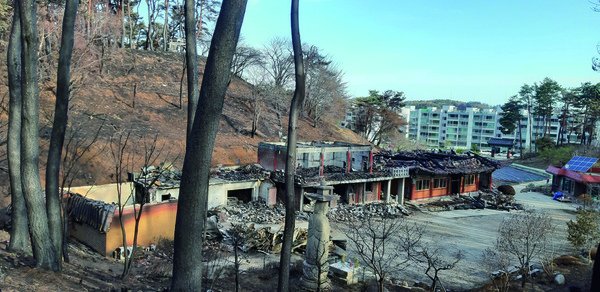
This isn't a thousand-year-old wooden temple. Let me be clear about that. Inwolsa was completely destroyed in the April 11, 2023 Gangneung wildfire that swept through Nangok-dong, taking 379 hectares of pine forest and 64 homes with it. The Daeungjeon main hall, the meditation center, and the Gwaneumjeon were reduced to ash. The bhikkhuni (nuns) who lived here escaped with only the robes on their backs and one wooden Buddha statue rescued from the smoke.
What you visit today was rebuilt over 33 months. Donations came from monks, lay Buddhists, and townspeople across Korea — roughly ₩4.8 billion in total. Architect Yoon Kyung-sik (윤경식) led the design. The temple reopened in February 2026, and one month later it took the WA Awards Grand Prize. First Korean Buddhist temple ever to win it.
Practical heads-up: no food vendors on site. Modest dress is appreciated — shoulders covered, no short shorts. The meditation hall closes to visitors during 06:00 morning chants and 18:00 evening chants, about 40 minutes each. You can listen from the courtyard. Honestly, the courtyard is the better experience anyway.
🌙 The Crescent Hall — Why the Architecture Is the Real Pilgrimage
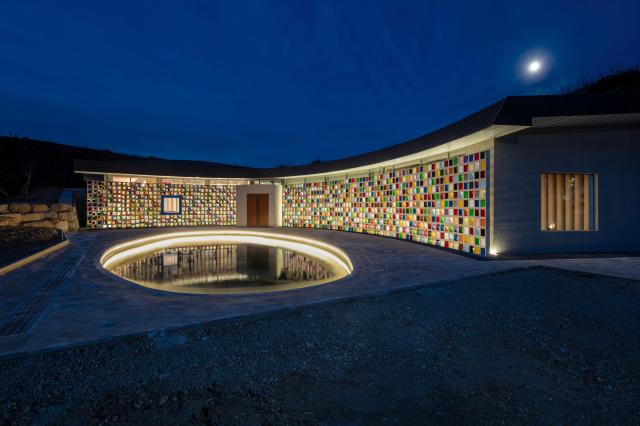
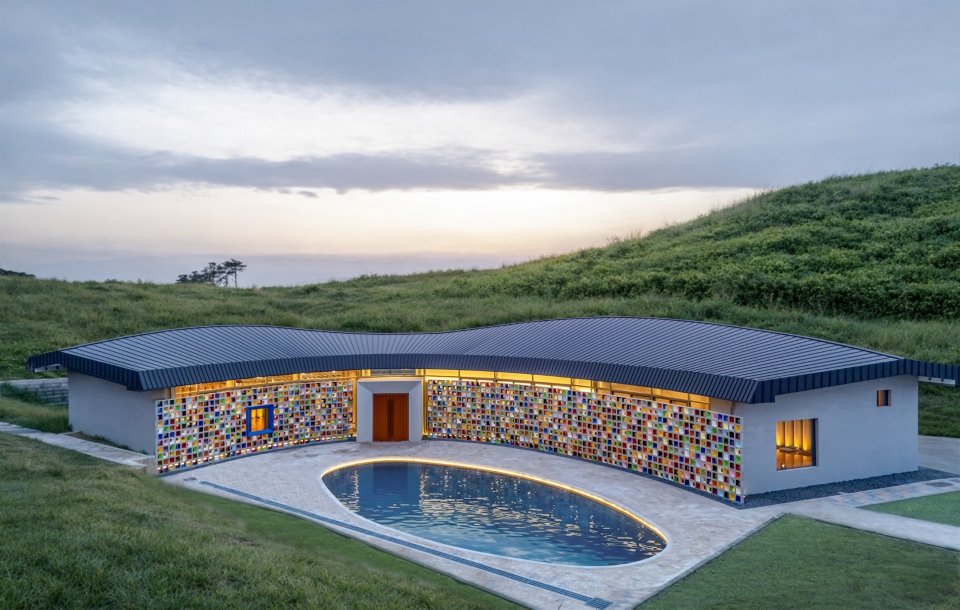
The main hall is shaped like the Buddha's eyebrow. Or a crescent moon, depending on where you stand. That curve isn't decoration. The name 印月 (Inwol) means "the moon imprinted on the water" — a reference to the reflection of the moon on nearby Gyeongpo Lake (경포호), 2.4 km east. Yoon designed the entire roofline to echo that one image.
Stand at the southern edge of the courtyard around 18:45 in spring. You'll see why the WA jury cited it. The curve frames Gyeongpo's water in the distance through a deliberate sightline cut between two old pine trees the fire somehow spared. I stood there for 20 minutes. Four other visitors found the same view independently while I was watching — each one stopped mid-step. That's not marketing copy. That's just what happens.
✨ Indra Net Facade — Stay Until Dark at Inwolsa Temple
The exterior walls are tiled with thousands of multi-colored glass blocks arranged in the pattern of the Indra Net (인드라망) — the Buddhist metaphor for infinite interconnection, where every jewel reflects every other jewel. During the day, the blocks pull daylight inward. The interior glows in shifting blues and ambers. After sunset, it reverses. Interior lighting pushes outward and the whole building becomes a single, slow-breathing lantern.
I shot here at 19:20 in April. Sunset around 19:00 in Gangneung this time of year. Got the best photos of my entire Gangwon-do trip — and I shot Mount Seoraksan two days earlier. Bring a tripod. The 5-second exposure on the north-facing wall is the shot. No photo restrictions outside the meditation hall. Drones are banned everywhere on temple grounds, and the staff will politely but firmly walk over if you try.
🪞 Mirror of Karma Pond — The Spot Locals Quietly Recommend
Behind the main hall sits a 12-meter shallow reflecting pool called the Eopgyeongdae (업경대). The Mirror of Karma. It's a reference to the Buddhist mirror said to reflect one's deeds in the afterlife. When the wind dies, the crescent hall doubles itself perfectly in the water. Korean visitors call it the "두 개의 달" shot. Two moons in one frame.
Go on a weekday morning before 10:00 if you want it empty. I went on a Friday at 9:15 and had the entire pond to myself for 25 minutes. By 11:00 a small Korean tour group had arrived and the reflection got disrupted by foot traffic on the surrounding stone path. The pond also freezes over from late December through early March, so if you're chasing the reflection shot, skip winter entirely.
⚠️ Honest Cautions — What Most Guides Won't Tell You
- One toilet block, ten stalls. Tour buses can clog it 11:00–13:00. Use the one at Gyeongpo Lake parking lot before you arrive.
- No café, no convenience store within 1 km. Bring water in summer, a thermos in winter.
- Selfie sticks discouraged inside the courtyard. Not banned, but staff will ask you to lower them near the meditation hall.
- Winter ice. The stone path around the Mirror of Karma freezes hard from December to February. Wear grippy shoes or skip the pond loop.
- Rainy day verdict: Worth it. The Indra Net facade looks even better under overcast skies. But the Mirror of Karma reflection dies in the rain ripple.
- Wildfire memorial wall on the east side. Quiet, sober, and not for selfies. Please skip the peace signs there.
💡 Which Visit Style Fits You Best?
Half-day cultural trip (3 hours): Temple only + Gyeongpo Lake walk. Best if you're car-free and taxiing from Gangneung Station. Budget ₩30,000 round trip in taxis.
Full-day Gangneung loop (8 hours): Inwolsa Temple in the morning → Chodang Sundubu lunch → Terarosa coffee → Anmok Beach sunset. This is what I did. It's the route I'd recommend to a first-time visitor without hesitation.
Photographer's overnight: Arrive 16:00. Shoot golden hour at the crescent hall. Stay for the lit Indra Net facade at 19:30. Sleep in central Gangneung (St. John's Hotel is 12 minutes away, ~₩180,000/night). Return at 06:30 for the empty Mirror of Karma. The temple genuinely rewards two visits in 24 hours.
📅 Parking, Getting to Gyeongpo Lake temple & Nearby Stops
Parking: The on-site lot holds about 40 cars. Free. It fills up on weekends between 11:00–14:00, so arrive before 10:30 or after 15:00. There's a small overflow gravel lot 200 meters down the access road — also free, 5-minute walk back to the gate.
Driving from Seoul: 2h 40m via Yeongdong Expressway, exit at Gangneung IC, then 12 minutes on local road. Set Naver Map to "인월사" exactly. Google Maps still lists the old pre-fire address and will dump you in an empty lot 1.2 km east. I learned this the hard way.
By KTX + taxi: Cheongnyangni Station → Gangneung Station (1h 50m, ~₩28,000). Taxi from Gangneung Station to the temple runs ₩11,000–13,000 and takes 15–20 minutes. Kakao T works fine here. Uber does not operate in Gangneung as of April 2026.
Nearby — Terarosa Gangneung Main (테라로사 강릉본점): 10 minutes by car. The original location of Korea's most influential specialty coffee roaster. Consistently top-3 on TripAdvisor Gangneung. Order the hand-drip Ethiopian Yirgacheffe (₩7,500). Closes 21:00.
Nearby — Chodang Wonjo Sundubu (초당 원조순두부): 10 minutes by car. The original soft-tofu restaurant in Chodang Tofu Village. Order the sundubu jjigae — ₩11,000, English menu available, no reservation needed. Cash and card both fine.
Nearby — Anmok Beach Coffee Street (안목해변 커피거리): 15 minutes by car. A 400-meter stretch of ocean-view cafés. Perfect sunset wrap-up after the temple if you're running the full loop in reverse.
❓ Gangneung hidden gem FAQ
Q1. How much does parking cost at Inwolsa Temple in Gangneung?
Parking is completely free. The temple maintains about 40 on-site spaces plus a small overflow gravel lot 200 meters away. There's no time limit. A ₩2,000–5,000 donation in the entrance box is customary and goes toward continued reconstruction work.
Q2. Do I need to reserve in advance to visit the WA Award winning temple in Gangneung?
No reservation is needed for individual visitors. Groups of 10 or more should email the temple office 3 days ahead for a free English-guided tour. The meditation hall closes to visitors during 06:00 and 18:00 chants (about 40 minutes each), but the courtyard and Mirror of Karma pond stay open.
Q3. What's the best time of day to photograph the Indra Net facade?
For the lit-up nighttime effect, arrive 30 minutes before sunset and stay 30 minutes after — roughly 18:30–19:45 in spring, 19:30–20:45 in summer. The crescent hall reflects best in the Mirror of Karma pond on calm weekday mornings before 10:00. Tripods are allowed everywhere except inside the main hall.
Q4. What's the best season to visit Inwolsa Temple in Gangneung?
Late April to early June is ideal — mild weather, pine pollen settled, Gyeongpo Lake greenery in full leaf, and sunset times that line up with the Indra Net lighting. Avoid July–August midday heat (Gangneung hits 33°C) and December–February ice on the Mirror of Karma stone path.
Q5. Can I bring food or drinks into Inwolsa Temple?
Water is fine. No outside food, alcohol, or meat-based snacks anywhere on temple grounds — this is a working bhikkhuni temple. There's no café or convenience store within 1 km, so eat before you come. Chodang Sundubu Village is 10 minutes away by car and pairs perfectly as a pre-visit meal.
Q6. Is high-tech tradition Korean temple worth visiting in the rain?
Yes, with one caveat. The Indra Net glass facade looks even more luminous under overcast skies and gentle rain, and the wet stone courtyard photographs beautifully. But rain kills the Mirror of Karma reflection, and the wooden boardwalk near the meditation hall gets slick — wear non-slip soles.
Three years ago this site was ash. Today it's an internationally recognized piece of architecture that still functions as a working bhikkhuni temple — and quietly, the most moving stop on any 2026 trip to Gangwon-do. If you're putting together a Gangneung itinerary, slot Inwolsa Temple Gangneung in as your morning anchor and let the rest of the day flow from there. Bring a wide lens. Modest layers. Time to sit by the pond. The building will do the rest.
'주차 정보' 카테고리의 다른 글
| 마포 문화비축기지 드라이브·주차 5분 정리 | 뷰티풀민트라이프 2026 당일 완벽 가이드 (0) | 2026.05.28 |
|---|---|
| 【2026最新】江陵インウォルサ寺院 完全ガイド|山火事から世界建築賞へ復活した必訪スポット (0) | 2026.05.27 |
| 【2026最新】韓国BBQの違い完全ガイド|サムギョプサルとウデカルビ比較・食べ方・マナーをソウル7年目が解説 (0) | 2026.05.24 |
| Korean BBQ Guide Seoul 2026: Samgyeopsal vs U-Dae-Galbi (Honest Foreigner Tips) (0) | 2026.05.24 |
| 콩국수 vs 막국수 2026 여름 솔직 비교 (가격·주차·칼로리 총정리) (1) | 2026.05.24 |

